
Independent Custody Visitors
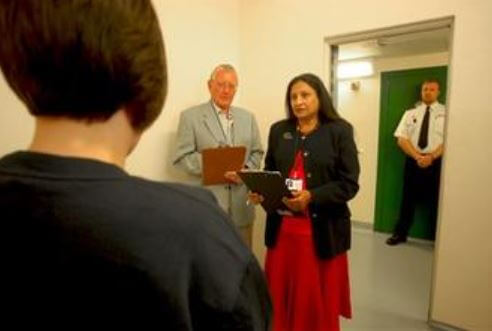
Independent Custody Visitors (ICVs) are members of the local community who volunteer to make unannounced visits to police custody suites.
They check on the welfare of detainees in police custody by speaking to those detained and monitoring the conditions of the cells. The visits provide an independent check on the way in which detainees are held, in accordance with strict guidelines laid down by the Police and Criminal Evidence Act 1984, and also help foster better public understanding and confidence in the way prisoners are treated.
ICVs check and make sure that:
- Detainees have been offered food and drink
- Detainees are warm enough
- Cells are in a reasonable condition
- Religious and cultural needs of the detainee have been considered
- Detainees have been informed of their rights
Visits are regularly made to designated police custody suites in Thames Valley:

What does the role involve?
The role of an Independent Custody Visitor is complex and varied. Following a recent police ride-along experience, we interviewed one of our ICVs to ask them what the role involves:
00:00:05:06 – 00:00:09:09
Now, the role itself is quite, unusual
00:00:09:14 – 00:00:13:00
that you go in unannounced
00:00:13:12 – 00:00:18:04
and you’re taken round to all of the detainees cells.
00:00:19:04 – 00:00:22:13
And check that all is in order, basically.
00:00:22:15 – 00:00:27:13
So you have a list of things that you’re supposed to have a look at
00:00:28:01 – 00:00:31:01
when you’re in there. Just notice.
00:00:31:02 – 00:00:34:15
And, obviously you ask very nicely
00:00:35:00 – 00:00:39:08
if the detainee is happy to speak to you, which, of course, we do.
00:00:39:09 – 00:00:44:04
And usually they’re quite grateful for a little bit of a chat with somebody.
00:00:44:11 – 00:00:48:02
It’s very important that we tell everybody
that we’re independent,
00:00:48:09 – 00:00:52:08
and that we’re nothing, absolutely nothing to do with the police force.
00:00:52:09 – 00:00:58:04
We really are a check and balance to go in and look at,
00:00:59:06 – 00:00:59:15
how the
00:00:59:15 – 00:01:04:01
detainees are being treated, what the cells are like,
00:01:04:03 – 00:01:09:05
if they’re comfortable, if all their needs are being met etc.
00:01:14:11 – 00:01:16:04
An Independent Custody
00:01:16:04 – 00:01:19:08
Visitor goes into a custody suite at a police station.
00:01:19:13 – 00:01:23:11
These are people who have been arrested and taken into custody,
00:01:24:02 – 00:01:26:06
before they actually go to court.
00:01:31:09 – 00:01:35:14
How you arrive at those conclusions
00:01:35:15 – 00:01:40:08
depends on the sort of questions you ask and how much you observe in the cell.
00:01:40:08 – 00:01:43:08
So, for example, when you open the door,
00:01:43:08 – 00:01:46:03
then you will say, I’m an Independent Custody Visitor.
00:01:46:03 – 00:01:48:05
I’m absolutely nothing to do with the police.
00:01:48:05 – 00:01:51:05
And may I ask you a few questions?
00:01:51:14 – 00:01:54:07
I’m here to check that everything’s alright.
00:01:54:07 – 00:01:56:08
Generally, they’re very pleased to talk to you.
00:01:56:08 – 00:01:58:09
And many will say, oh, yeah, I’m very comfortable.
00:01:58:09 – 00:02:00:02
It’s perfect, I’m warm, you know.
00:02:00:02 – 00:02:04:06
And so if they’re not I’ll say “Would you like some more blankets, are you hungry?”
00:02:04:11 – 00:02:06:02
And they’ll say, no, they’ve eaten.
00:02:06:02 – 00:02:07:04
And if they haven’t eaten,
00:02:07:04 – 00:02:11:04
they’ll probably give you a reason why. They’re either are anxious, or whatever.
00:02:11:08 – 00:02:16:00
You’ll ask them if they might like something to read, for example.
00:02:16:01 – 00:02:18:08
And because there’s a little library
00:02:18:08 – 00:02:21:08
check if they’re female, that they’ve got hygiene pack
00:02:21:10 – 00:02:25:03
or, if they’re of a certain age, if they’ve got a menopause pack.
00:02:25:06 – 00:02:30:04
And also there’s access to religious items
00:02:30:05 – 00:02:34:05
if they want to pray or whatever, you know, meditate.
00:02:34:08 – 00:02:38:02
And so we make sure that they’ve got these kind of things.
00:02:38:15 – 00:02:41:12
And any kind of reading material.
00:02:41:12 – 00:02:44:12
And also there’s a blackboard in all the cells.
00:02:44:13 – 00:02:49:07
And so, you know, we offer chalks, they want to do a Banksy or they want to,
00:02:49:08 – 00:02:51:03
you know, write their whatever.
00:02:51:03 – 00:02:52:00
Anything down.
00:02:52:00 – 00:02:55:02
Anything to, kind of, make them feel comfortable.
00:02:55:05 – 00:02:58:12
Because it’s not a very comfortable situation to be in.
00:02:59:02 – 00:03:02:03
And but more than that, it’s about checking the cleanliness,
00:03:02:08 – 00:03:04:13
whether or not they’re being treated.
00:03:04:13 – 00:03:07:06
They perceive they’re being treated well.
00:03:12:14 – 00:03:15:13
I was very fortunate
00:03:15:13 – 00:03:19:09
to be given the opportunity to go on a police ride along,
00:03:20:07 – 00:03:22:11
and this meant that
00:03:22:11 – 00:03:26:13
I went along in a police car following them round on their duties.
00:03:26:15 – 00:03:30:04
But I went along to police custody.
00:03:31:07 – 00:03:34:14
The police station, and I was met
00:03:34:14 – 00:03:40:04
by the sergeant in charge of that particular duty.
00:03:41:02 – 00:03:46:06
And, he took me in, and I wanted to be part of the briefing
00:03:46:09 – 00:03:50:09
because I thought that was really important to see how it all starts.
00:03:50:10 – 00:03:53:09
And so everybody assembled at 1.45 in the afternoon
00:03:53:09 – 00:03:57:10
for the evening slot.
00:03:57:14 – 00:04:03:04
And, I sat in on the briefing,
00:04:03:08 – 00:04:07:08
which involved several police stations,
00:04:08:10 – 00:04:10:14
which I didn’t realise that was what was going to happen.
00:04:10:14 – 00:04:14:03
I thought it would just be the people at that particular station, and it wasn’t,
00:04:15:01 – 00:04:18:15
and, just important administrative things.
00:04:18:15 – 00:04:22:05
They needed to know what was happening generally,
00:04:22:13 – 00:04:25:11
and if there were any problems, they were all told about it.
00:04:25:11 – 00:04:27:10
And I found that really quite fascinating.
00:04:32:14 – 00:04:34:00
We went to
00:04:34:00 – 00:04:37:05
a missing persons where a child from school, hadn’t
00:04:37:06 – 00:04:41:00
actually arrived at school that morning and hadn’t arrived home that evening.
00:04:41:04 – 00:04:45:03
And so that was what I was part of that day.
00:04:45:05 – 00:04:48:03
This missing persons, this young lad.
00:04:48:03 – 00:04:51:05
And so we went to a town nearby,
00:04:53:02 – 00:04:57:04
where he lived, and to visit the parents.
00:04:57:10 – 00:05:01:13
And we questioned them
00:05:02:09 – 00:05:06:05
and basically then we went on a search around the area to find him.
00:05:06:08 – 00:05:09:12
He had done it before, so he was known
00:05:10:02 – 00:05:12:14
as somebody who was likely to go missing, obviously.
00:05:12:14 – 00:05:16:10
And he, but he had turned up the previous time.
00:05:16:11 – 00:05:21:13
And so the police were quite confident that he would turn up eventually,
00:05:21:13 – 00:05:25:14
but nonetheless, they treated it with utter seriousness.
00:05:26:02 – 00:05:30:03
And we trailed the streets
00:05:30:09 – 00:05:35:02
in the car with, you know, looking for this boy where he might be.
00:05:40:06 – 00:05:40:13
I felt
00:05:40:13 – 00:05:43:13
I was totally included in this experience.
00:05:43:15 – 00:05:46:11
So it was totally worthwhile.
00:05:46:11 – 00:05:50:15
And I would recommend anybody to do it because it was very,
00:05:50:15 – 00:05:53:15
very interesting.
00:05:58:07 – 00:06:01:15
I was struck by how empathetic
00:06:02:00 – 00:06:06:12
the police officers were with the uncle and the uncle’s wife.
00:06:06:13 – 00:06:10:04
And how, respectful
00:06:10:04 – 00:06:13:05
there were of the house that they were visiting.
00:06:13:06 – 00:06:16:14
And they always asked permission to do anything,
00:06:16:14 – 00:06:20:09
whether it’s do you mind if I sit, or do you mind if I go upstairs or etc.
00:06:20:09 – 00:06:22:14
and which I was, I was struck by.
00:06:28:03 – 00:06:30:14
I was really keen to know
00:06:30:14 – 00:06:33:14
if they found him, but I never did find out.
00:06:40:11 – 00:06:41:09
I think it’s
00:06:41:09 – 00:06:45:04
really important that we have these groups, like
00:06:45:05 – 00:06:50:15
Independent Custody Visitors going in and scrutinising the police force.
00:06:50:15 – 00:06:56:00
The police people are public servants, and they serve us.
00:06:56:03 – 00:06:59:13
And therefore, I do believe that they really
00:06:59:14 – 00:07:02:14
should be scrutinised and held accountable.
00:07:02:15 – 00:07:07:13
And so I think it’s absolutely vital that there are people like us going in
00:07:08:12 – 00:07:11:06
independently and
00:07:11:06 – 00:07:14:08
overseeing what’s actually happening inside.
00:07:19:13 – 00:07:20:10
I encourage
00:07:20:10 – 00:07:24:03
anybody who’s interested to take part in the ride along scheme.
00:07:24:14 – 00:07:29:09
Just go to the Thames Valley Police website, click on the ride along scheme,
00:07:29:11 – 00:07:35:03
and you have to fill out a few forms, and get involved.
00:07:35:04 – 00:07:36:10
It’s fascinating.
00:07:36:10 – 00:07:40:06
Similarly, the job as Independent Custody
00:07:40:15 – 00:07:44:02
Visitor is so interesting
00:07:44:07 – 00:07:47:04
and so valuable.
00:07:47:04 – 00:07:49:13
If you think you fit the bill, apply.
How can I get involved?
To become a custody visitor, you need to be at least 18 years old and independent of the police. Serving police officers, police staff, special constables, justices of the peace and Office of the Police and Crime Commissioner staff, for example, will not be considered.
If you meet this criteria, you’ll need to complete an application form which will be followed by an interview and short induction programme if you’re successful. After this, there will be a six-month probationary period which will need to be satisfactorily completed before a full appointment can be confirmed.
Case study – Paul (Volunteer Independent Custody Visitor)

Paul volunteers as an Independent Custody Visitor at Aylesbury Police Station. He feels that this is an important role and says that, as with his many other volunteering roles, he gets far more out of the experience than he feels he puts in.
What is your role?
I’m part of a team of independent custody volunteers who make unannounced visits to people held in police custody to check on their rights, entitlements, wellbeing and dignity. The independent custody visiting scheme is run by the Office of the Police and Crime Commissioner. My custody visits are all to Aylesbury Police Station.
What attracted you to this role?
I have been volunteering for years in various roles, including those that the VMS matched me to. They have always tended to be practical roles, very worthwhile and rewarding but the Independent Custody Visiting role offered more of an intellectual challenge than some other roles. I had worked for the Police Service many years ago and that also played a part in piquing my interest.
What difference do you think your role makes?
It is an opportunity to be an independent voice commenting on the running of the custody process. It is important to both the person being detained and to the Police who have placed that person in custody, providing an independent perspective to both sides.
Was there a long induction process before you could get started?
It did take a while – I was matched to the role in July but did not do my first custody visit until December. I remember that, for a while, visits were difficult to do because of Covid-19. Both the interview stage and the induction process were positive experiences and so didn’t dampen my enthusiasm for the role.
What has the experience been like so far?
It is living up to my expectations, and the induction process prepared me very well, so there have been no real surprises. The most interesting bit is meeting people in very unusual circumstances and working out how to have a conversation with them that reassures them of my independence and can establish whether they are being properly treated without prying into how they came to be detained. Some detainees definitely welcome the human element that the custody visits provide.
Would you recommend this role to others?
Yes, I am enjoying it and would be happy to talk to anyone about the role. Anyone who has an independent perspective, and an open mind, could volunteer as a custody visitor.
Would you recommend volunteering generally?
Yes. It seems to me that in every role I have, I get more from the experience than I feel I have given. I have met such a variety of people that I would not otherwise have done. Most importantly, I feel I am part of something that is delivering for the common good.
Further information
The Independent Custody Visiting Association (ICVA) have produced a short video which details the role of a Custody Visitor:
If you would like to know more about the role, please contact the Scheme Manager by emailing custodyvisiting@thamesvalley.police.uk
For more information, please visit the Independent Custody Visiting Association (ICVA) website:
NOTE Thames Valley ICV Scheme abides by the Home Office Code of Practice on Independent Custody Visiting:
How to apply
Please follow the below buttons to apply for the role of Independent Custody Visitor and to view the role description:
We are committed to building a diverse and inclusive Independent Custody Visiting Scheme that reflects the communities we serve across Thames Valley.
As part of our team, you’ll be joining an organisation that values and respects every individual—regardless of age, disability, gender identity, marital status, pregnancy or maternity, race, religion or belief, sex, or sexual orientation.
We strive to create a welcoming environment free from discrimination, harassment, or bullying. Our volunteers play a vital role in safeguarding the rights and welfare of people in police custody, and we expect all Independent Custody Visitors to uphold the principles of fairness, dignity, and respect in everything they do.
We welcome applications from people of all backgrounds. If you share our commitment to equality and want to make a meaningful difference in your community, we’d love to hear from you.
Should you have any questions regarding the role or would like further information, please email us as custodyvisiting@thamesvalley.police.uk.
Reports
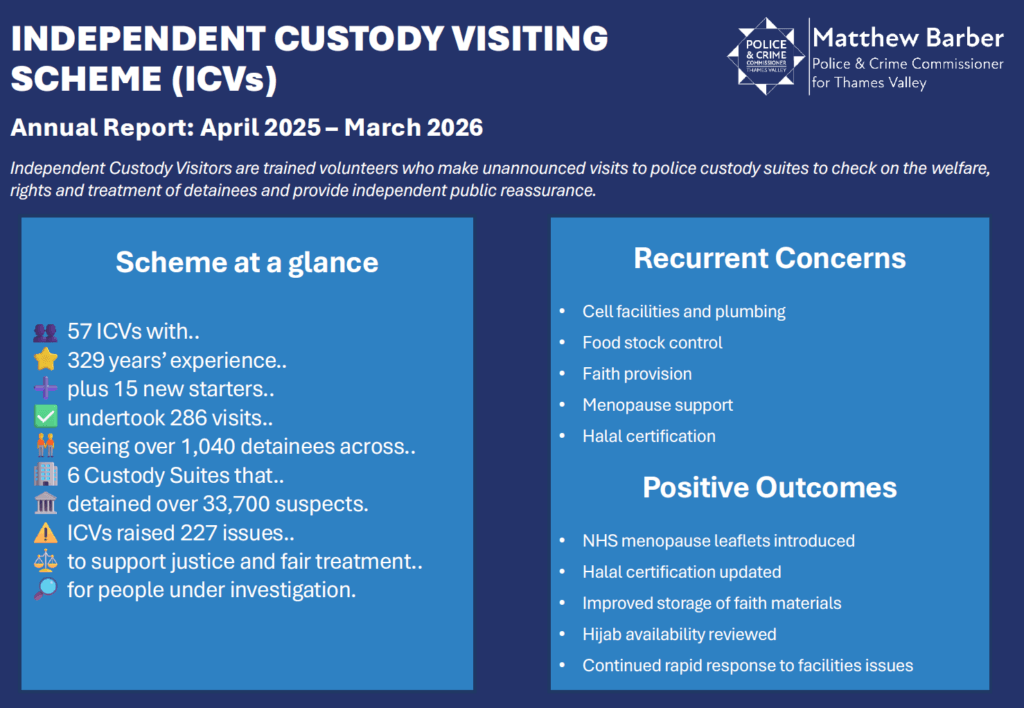
Following the publish of this year’s Annual Report, Matthew Barber (Police & Crime Commissioner for Thames Valley) said:
“It is a pleasure to recognise the valuable contribution made by the Independent Custody Visiting Scheme (ICVS) over the past year.
“ICVs plan an important role in providing reassurance that people detained in police custody are treated fairly, with dignity and respect, while also providing an important independent perspective on the operation of custody facilities.
“I would like to thank all our volunteers for the time, commitment and professionalism they continue to give to the scheme. Their contribution is greatly valued by me and by the wider policing community.”
Gillian Ormston, Chief Executive, added: “I am delighted to recognise the wonderful contribution made by our Independent Custody Visitors. Their professionalism, commitment, and enthusiasm are hugely valued, and the time they give to the scheme makes a real difference. I know personally the dedication that ICVs bring to their role, and I would like to thank each and every one of them for the care and passion they show in carrying out this important work.”
You can view previous reports in our archive.
Sign up to our newsletter
If you would like to hear the latest news and views from your Police & Crime Commissioner, please click the button below to sign up to our regular newsletter:

Additional resources
Find out how you can contact the PCC

Stay up to date with the work of the PCC